Start here: tap the TLP logo
anytime to return home.TLP logo
anytime to return home.TLP logo
Choose what you want to view
or which section you want to read.sport sections
or which section you want to read.sport sections
Every fall Saturday, you sit down to a game that feels like it has always looked this way. None of it fell out of the sky. Here are the five programs that changed what the game is — not just who won on a given weekend.
Browser voice · ready when you are
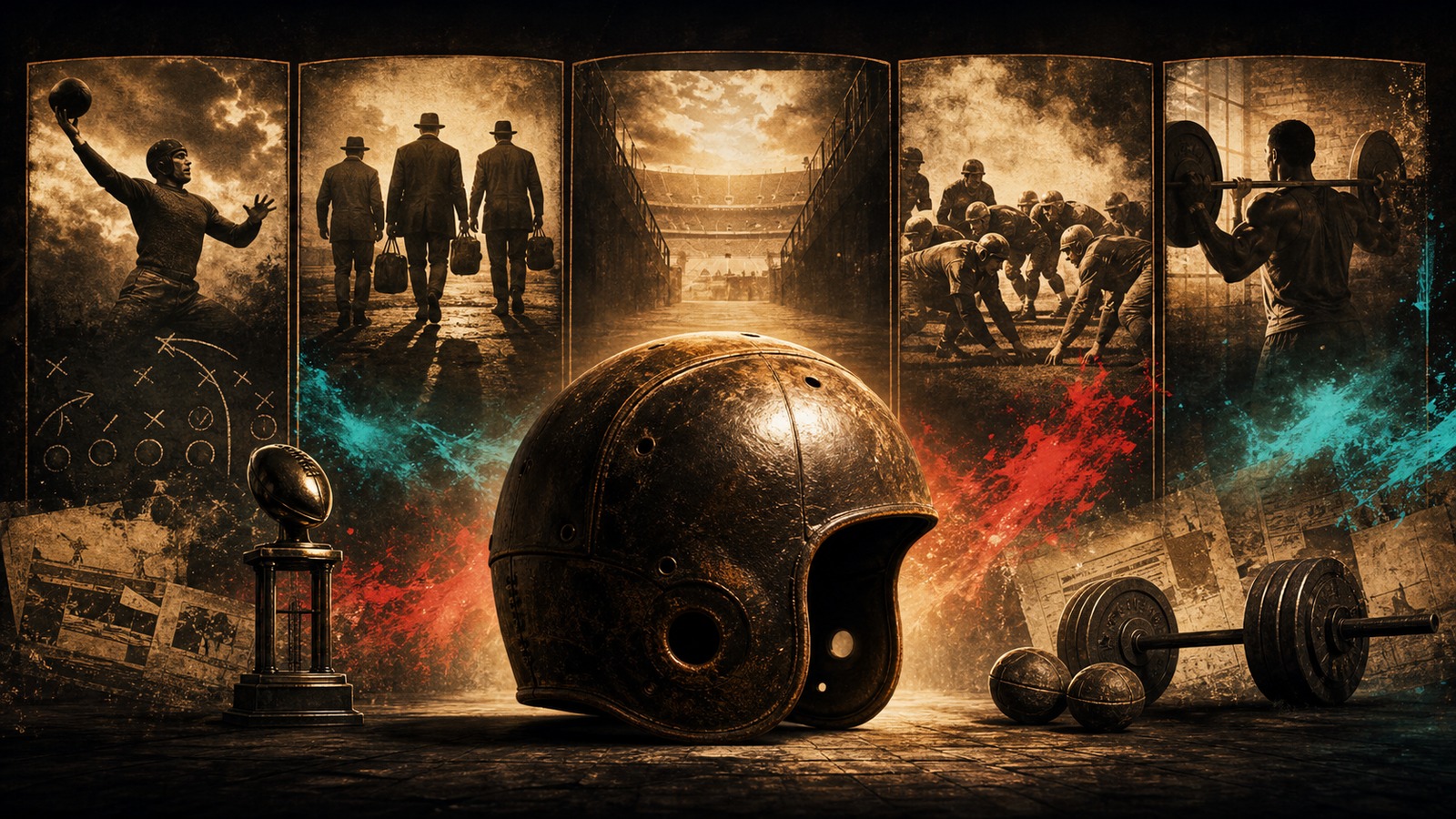
Every fall Saturday, you sit down to a game that feels like it has always looked this way. Two full squads trading places at the change of possession. A quarterback dropping back to throw as the first option, not the last resort. Linemen the size of the men who protect presidents. None of it fell out of the sky. Somebody built each piece, at a specific place, on a specific day, usually because they had no other way to win. Here are five programs that changed what the game is — not just who won on a given weekend. We are not ranking them. Each one moved the sport in a direction it never came back from.
You have heard that Notre Dame invented the forward pass. Set that down gently; it isn’t true. The pass was legalized in 1906, and other schools threw it first — St. Louis University under Eddie Cochems in 1906, Pop Warner’s Carlisle teams a year later. What Notre Dame did on November 1, 1913, at West Point was harder and more lasting: they proved it could win a real game against a real power.
Notre Dame was a small Midwestern school nobody in the East respected, taking the train to play Army for a $1,000 guarantee coach Jesse Harper had to haggle for. Quarterback Gus Dorais completed 14 of 17 passes for roughly 243 yards, throwing to an end named Knute Rockne on the run — a receiver catching in stride, which almost nobody was doing yet. Notre Dame won 35–13. The New York Times called it the most sensational football seen in the East that year.
Here is the specific thing that mattered. Before that afternoon, the pass was treated as a trick — a desperate heave, hemmed in by penalties, distrusted by the old guard at Harvard and Yale. Dorais and Rockne showed it could be an offense, run with timing and precision, safe enough and lethal enough to build around. It did not change the game overnight; there was no film, no clinic circuit, and coaches were slow. But the reputation was instant, and the idea was loose in the world. Every empty backfield you will see this weekend traces back, in part, to a cold day at West Point in front of 5,000 mostly Army fans.
For 56 years, one man ran the football program at a school in the piney woods of northern Louisiana, and by the time he was done he had changed who gets to play professional football in America.
Eddie Robinson took the job at what was then Louisiana Negro Normal and Industrial Institute in 1941, with no assistants and a budget so thin he mowed the field, taped the ankles, and wrote up the game stories for the local paper himself. He retired in 1997 with a record of 408–165–15 — the winningest coach in the history of college football at the time, the first ever to reach 400 wins. In 1985 his 324th victory passed Bear Bryant’s career record, and Robinson became the first HBCU figure to appear on the cover of Sports Illustrated.
But the wins are not the reason Grambling shaped the sport. This is: he ran the pipeline. More than 200 of Robinson’s players went on to professional football during decades when major Southern universities were still closed to Black athletes. It started with Paul “Tank” Younger, who in 1949 became the first player from an HBCU to sign in the NFL, with the Los Angeles Rams. Four Robinson players reached the Pro Football Hall of Fame — Willie Davis, Willie Brown, Buck Buchanan, and Charlie Joiner. He coached James Harris, one of the first Black quarterbacks to start a season opener in the modern NFL, and Doug Williams, the first Black quarterback to win a Super Bowl, who came home to succeed Robinson as Grambling’s head coach.
By the 1960s, sportswriters noted that Grambling was sending more men to the pros than any school in the country except Notre Dame. That is what did the work. When talent that good keeps coming from one address, the scouts have to show up — and they came to Grambling, to campuses the league had spent years overlooking. Robinson did not need to file a lawsuit or give a speech. He just kept producing players nobody could pretend not to see. That lineage of Black college excellence is what the Celebration Bowl puts on a national stage every December now.
If you want the single rule change that made the modern athlete possible, it happened partly by accident, out of wartime desperation, in a game Michigan lost.
For most of football’s life it was an ironman sport: eleven men played all sixty minutes, offense and defense both, because a player pulled from the field usually couldn’t return that quarter. In 1941 the rules committee — chaired, in an irony he would later regret, by Michigan’s Fritz Crisler — approved unlimited substitution as a temporary measure while war drained the rosters. Everyone assumed coaches would use it to spell a tired man here and there.
Crisler used it to reinvent the game. On October 13, 1945, at Yankee Stadium, his young, undermanned Michigan team faced an Army juggernaut stacked with future Heisman winners Doc Blanchard and Glenn Davis. Outgunned, Crisler split his roster into a unit that played only offense and a unit that played only defense, swapping them wholesale with each change of possession. Michigan lost, 28–7. But the idea was too good to lose with them.
Army’s Red Blaik adopted it and gave it the military name that stuck: the platoon. Within a few years the two-platoon system was everywhere teams had the bodies for it. Specialization followed — players who did one thing, coaches who coached one side, the speed and precision the game now demands. Crisler himself grew uneasy with what he’d unleashed and helped roll it back in the 1950s, but it returned for good in 1965. Every offensive and defensive unit that trots on and off your screen on Saturday is his 1945 gamble, made permanent.
Alabama’s mark on college football is the simplest to state and the hardest to match: nobody won like Bear Bryant, and one game he arranged helped change who his sport would let compete.
Bryant returned to his alma mater in 1958 and coached the Crimson Tide for 25 years. Six national championships. Thirteen SEC titles. Twenty-four straight bowl games. He retired in 1982 with 323 wins, the most in major college football history at the time, his houndstooth hat and rolled-up game plan already the most recognizable silhouette in the sport. In 1971, with the program having slipped, he tore up his offense and installed the wishbone overnight — and rode it to three more national titles before the decade was out. That is a résumé that essentially defines what a blue-blood program looks like.
The harder, more honest part of the legacy is integration, and it deserves the full picture. Bryant was late — Alabama did not field a Black player until 1971, after every SEC school but Vanderbilt had already integrated, and historians rightly push back on any telling that casts him as an early crusader. But the way he brought his fan base along still mattered. In 1970 he invited John McKay’s fully integrated USC team to Birmingham; USC won 42–21, with a backup fullback named Sam Cunningham running for 135 yards (Source: Wikipedia, Sam Cunningham; ESPN retrospective), and the game gave Bryant the cover to do what politics in Alabama had blocked. Wilbur Jackson had already been signed; John Mitchell took the field in 1971 and later became Bryant’s first Black assistant. Within a decade Alabama went from zero Black players to a roster full of them, and three more championships. The change came late. It came all the same, and where Alabama went, the rest of the deep South followed.
The last piece is the one you can see with your own eyes every time the teams line up: the sheer size and speed of the bodies. That started with an injured pole vaulter in a 416-square-foot room in Lincoln.
In the 1960s, the accepted wisdom was that lifting weights made an athlete slow and muscle-bound. Boyd Epley, a Nebraska vaulter sidelined by a back injury, was rehabbing in the school’s cramped weight room when the football players started copying his lifts — and coming back stronger. A young assistant named Tom Osborne noticed those players returning better than they’d left, and pushed head coach and athletic director Bob Devaney to take a chance. In August 1969, Devaney hired Epley as the first full-time strength and conditioning coach in the history of college football. His parting instruction: if anyone gets slower, you’re fired.
Nobody got slower. Nebraska went 9–2 that fall, then won back-to-back national titles in 1970 and 1971. The program Epley built, “Husker Power,” became the model the entire country copied — Woody Hayes, Barry Switzer, and half the sport were soon calling Lincoln to ask how. In 1978 Epley gathered dozens of strength coaches in Nebraska to found what became the National Strength and Conditioning Association, turning a job that hadn’t existed into a profession that now certifies tens of thousands. Every weight room, every strength staff, every reason today’s linemen look the way they do runs back to a $2-an-hour hire nobody expected anything from.
TLP Sports Club — The Legacy Report covers the history of college football for the fans who live it. One Vision. One Voice.
Disclaimer: TLP Sports Club employs AI agents in our publications. We follow a rigorous editorial standard — sourcing, verification, and human review before any piece publishes. Even so, AI, like the humans who edit it, can make mistakes. We trust our readers to check the sources cited here for themselves. If you find an error, tell us. We will correct it.
You're one of our first visitors. This site is still under development — if you spot anything off, please let us know. Your eyes help us build something great.
Your feedback and this page’s address are sent to TLP Sports Club using Google Forms. Privacy Policy
Fan Discussion
Choose a display name and join the conversation. No GitHub sign-in.