Start here: tap the TLP logo
anytime to return home.TLP logo
anytime to return home.TLP logo
Choose what you want to view
or which section you want to read.sport sections
or which section you want to read.sport sections
Colorado beat Weber State 52–21, but the score is not the whole story. Eleven-four yards per pass attempt, a redshirt freshman quarterback growing into the job, and a defense creating pressure explain what Colorado's second game actually showed.
Browser voice · ready when you are
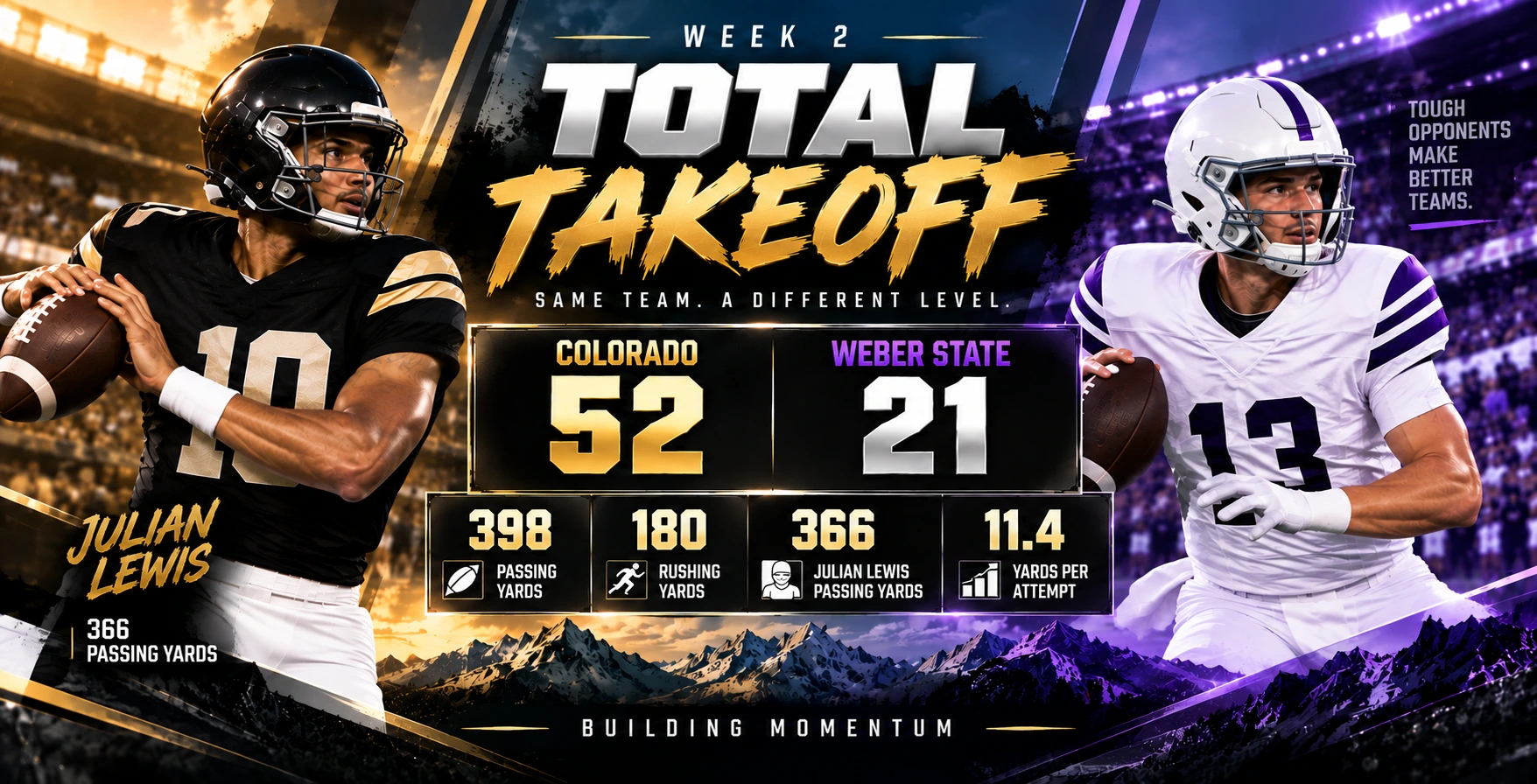
The scoreboard read 42 to 14 before most of Boulder had found its seat for the second half.
Julian Lewis threw one ball 66 yards before the student section had finished its first song.
By the time anybody checked the clock, it read 14:25, first quarter, and Colorado already had the answer to the only question that mattered — for one Saturday, anyway.
The number is 366. Three hundred sixty-six passing yards, on twenty-three attempts, for a redshirt freshman who wasn’t holding a starting job in the Big 12 twelve months ago. Four touchdown throws. One more on the ground. Five times Saturday, Julian Lewis made a football do something a Weber State defender couldn’t answer, and the fifth time was the one with his own two legs, a three-yard sneak that read less like a stat and more like a signature.
But the number that actually explains what happened at Folsom Field isn’t 366, and it isn’t 52. It’s 11.4.
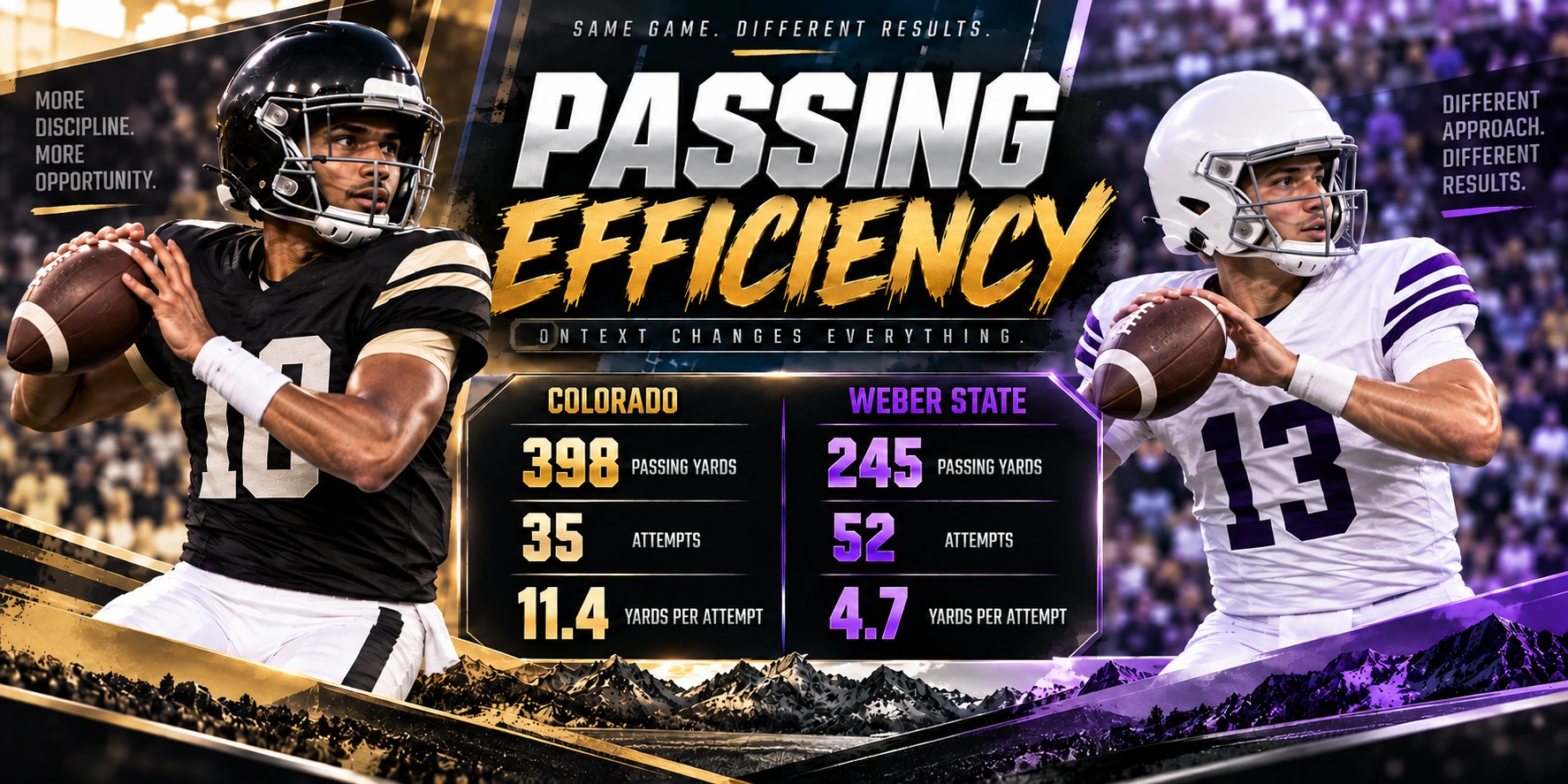
Colorado averaged 11.4 yards on every pass Lewis threw. Weber State averaged 4.7 on every pass Nate Dahle threw. Strip away the box score’s noise — the total yardage, the 30-minute time of possession split that came out almost even, 30:05 to 29:55 — and that 6.7-yard gap is the whole game. Two offenses ran nearly the same number of plays for nearly the same amount of time. One of them turned a snap into ground the other one couldn’t buy. Weber State needed fifty-two throws to find 245 yards. Colorado needed thirty-five to find 398. That is not a team that played from ahead. That is a team that played a different sport for three hours, and it’s the kind of afternoon where the band probably ran out of songs before Colorado ran out of touchdowns.
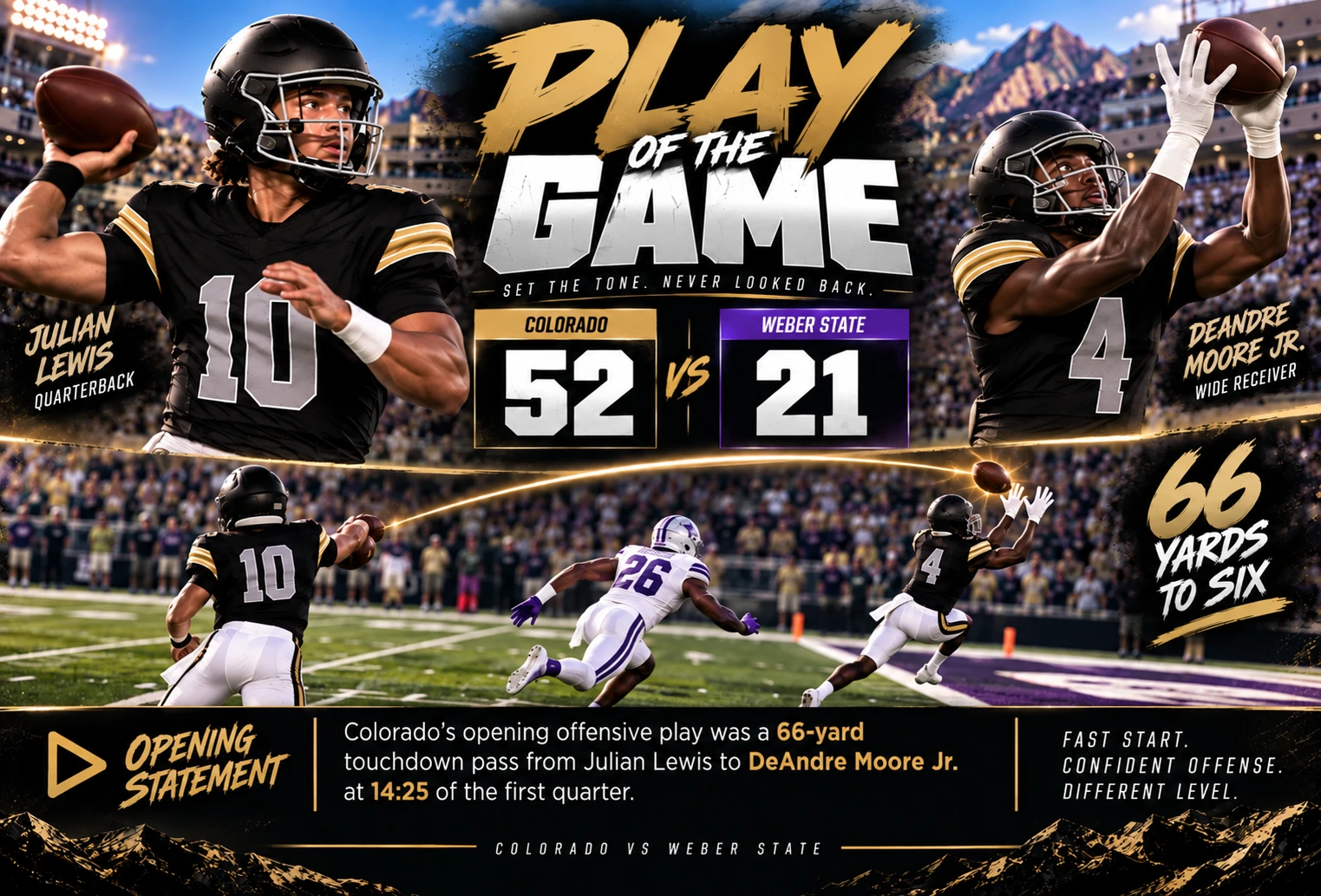
The play that set the tone arrived before the crowd had settled: Lewis, first possession, launching one down the left hash to DeAndre Moore Jr., who ran under it in stride and didn’t break stride again until he was sixty-six yards and one touchdown deep into his afternoon. It wasn’t the prettiest catch of the day — Joseph Williams matched it for splash later, four catches for 123 yards and two scores of his own — but it was the one that told Weber State’s defense exactly what kind of night it was going to be, in the first five minutes, before either sideline had adjusted to anything.
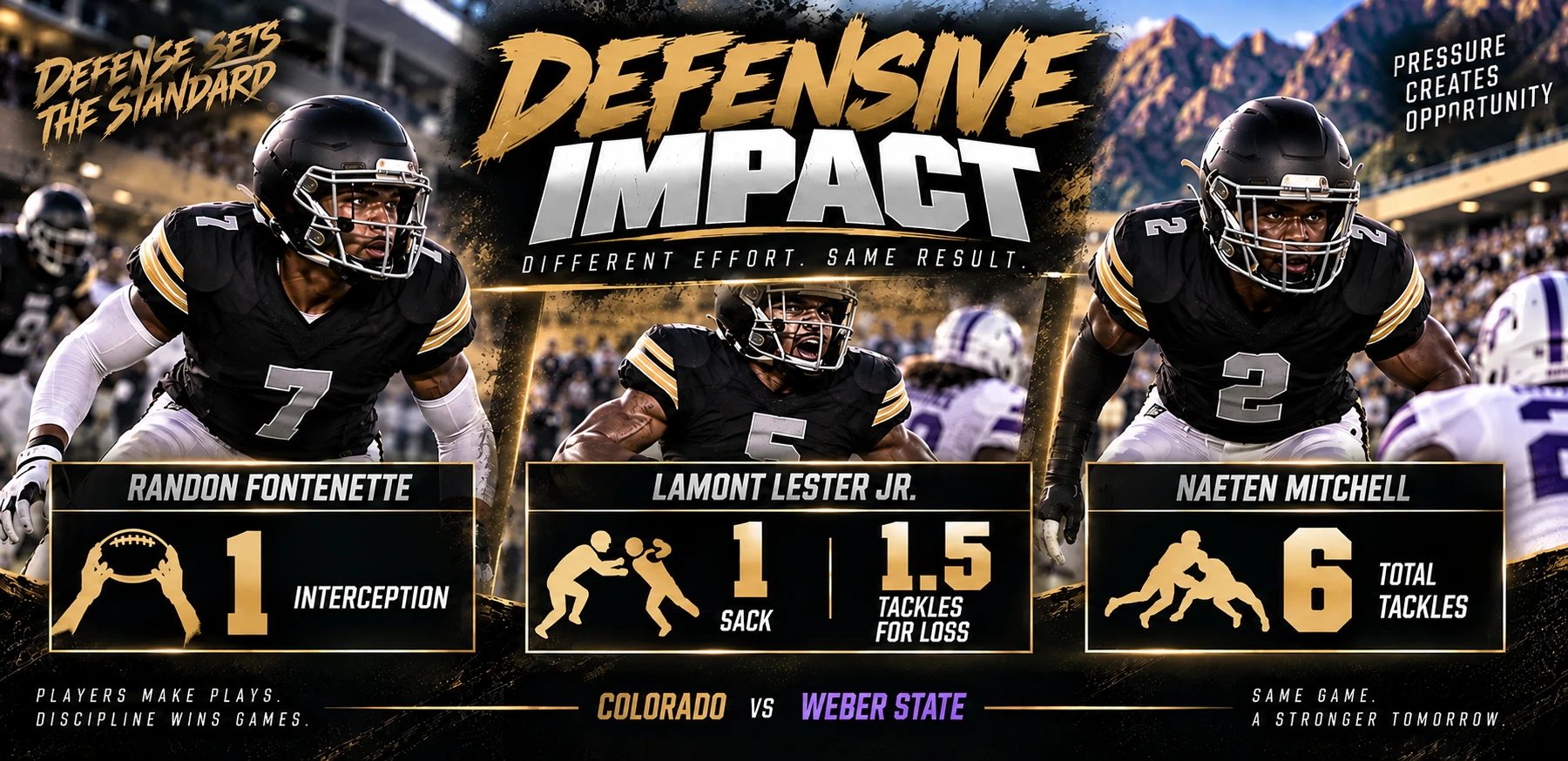
Numbers alone don’t win football games. People do. And on a Saturday when the box score reads like a track meet, it’s worth remembering that somebody has to actually stop the bleeding on the other side of the ball, too. Randon Fontenette picked off Dahle. Lamont Lester Jr. put him on the ground for a sack and added a tackle for loss on top of it. Naeten Mitchell led Colorado’s defense with six tackles. None of that shows up on a highlight reel next to a 66-yard touchdown. All of it is why Weber State’s 21 points weren’t 42.
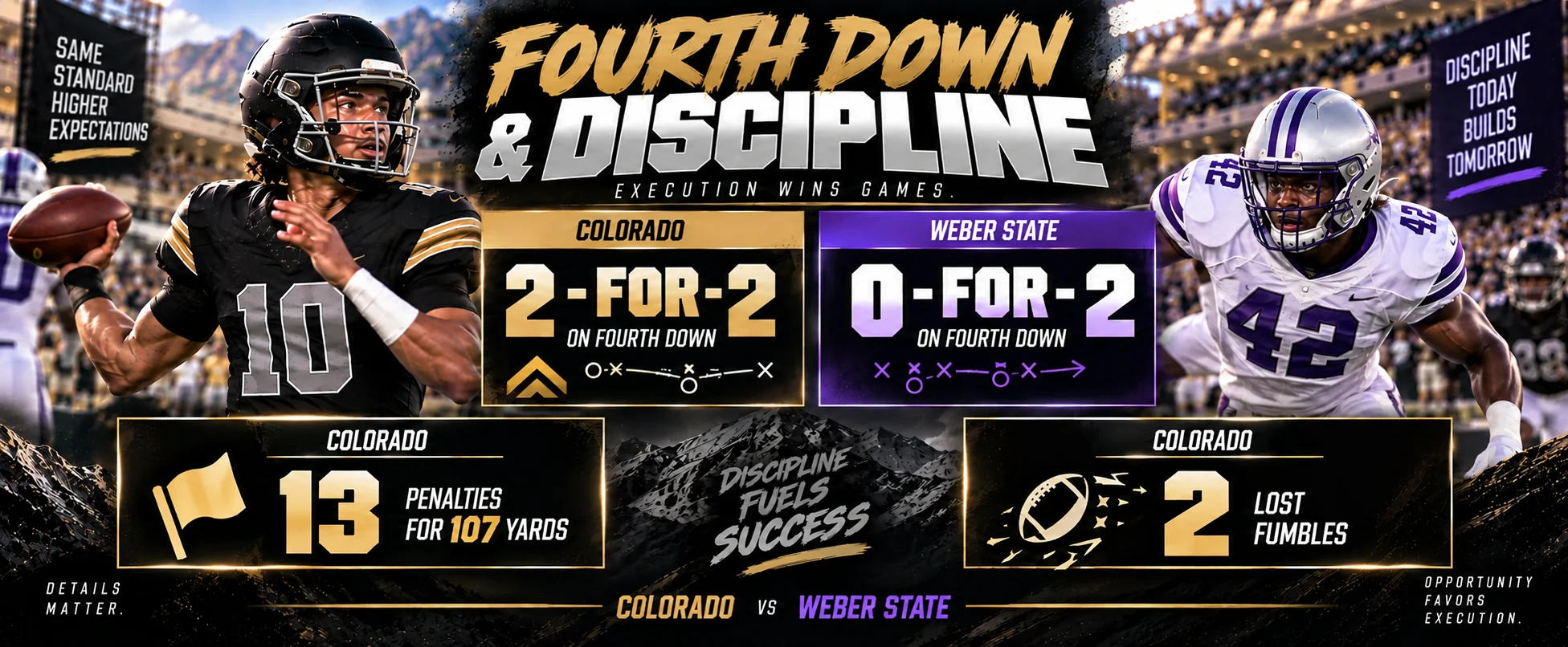
Here’s the stat the headline never tells you: Colorado converted two fourth downs out of two tries. Weber State converted zero out of two. That’s not a footnote — that’s a team that trusted its offense enough to go for it, twice, and got paid both times, while thirteen penalties for 107 yards and two lost fumbles piled up on the other side of the ledger and still didn’t matter. A team playing clean football with those numbers loses that game. Colorado didn’t need clean. Colorado needed efficient, and efficient is what showed up.
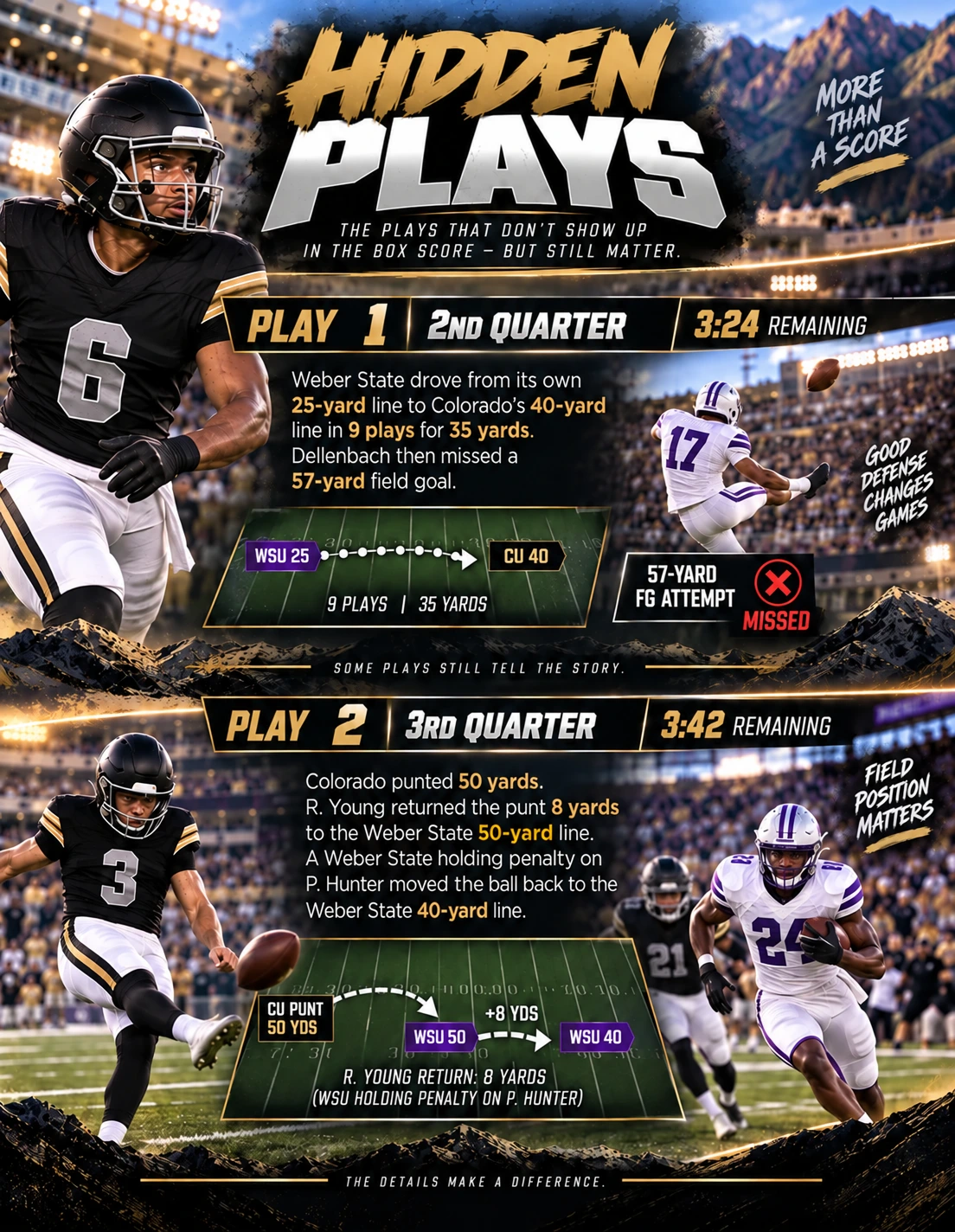
Look past the touchdowns and there’s a hidden version of this game, too — the version where nobody scored and it still counted. Late in the second quarter, Weber State drove nine plays and thirty-five yards, all the way to the Colorado 40 — and came away with nothing when David Dellenbach’s 57-yard field goal attempt sailed wide. No points changed hands on that snap. The margin did. And in the third quarter, a 50-yard Colorado punt to the Weber 42 turned into an 8-yard return by R. Young that never counted — a holding penalty wiped it out and pushed Weber State back to its own 40, ten yards of real estate it had already earned back and then lost again. Field position is a quiet kind of violence. Nobody chants for it. It still shows up on the scoreboard eventually.
There’s a category this formula asks for that stays empty tonight, and it stays empty on purpose: the player whose work never made a stat sheet, the block or the coverage assignment nobody’s counting yet. The grades aren’t final. The tape isn’t fully graded. Rather than hand out a name to fill a blank, this one waits — because the players who do that kind of invisible work deserve a real answer, not a guess dressed up as one.
Eleven-point-four yards a throw is a real number. It is also a number that cannot tell you why it happened, and that’s the part worth sitting with before anybody gets carried away.
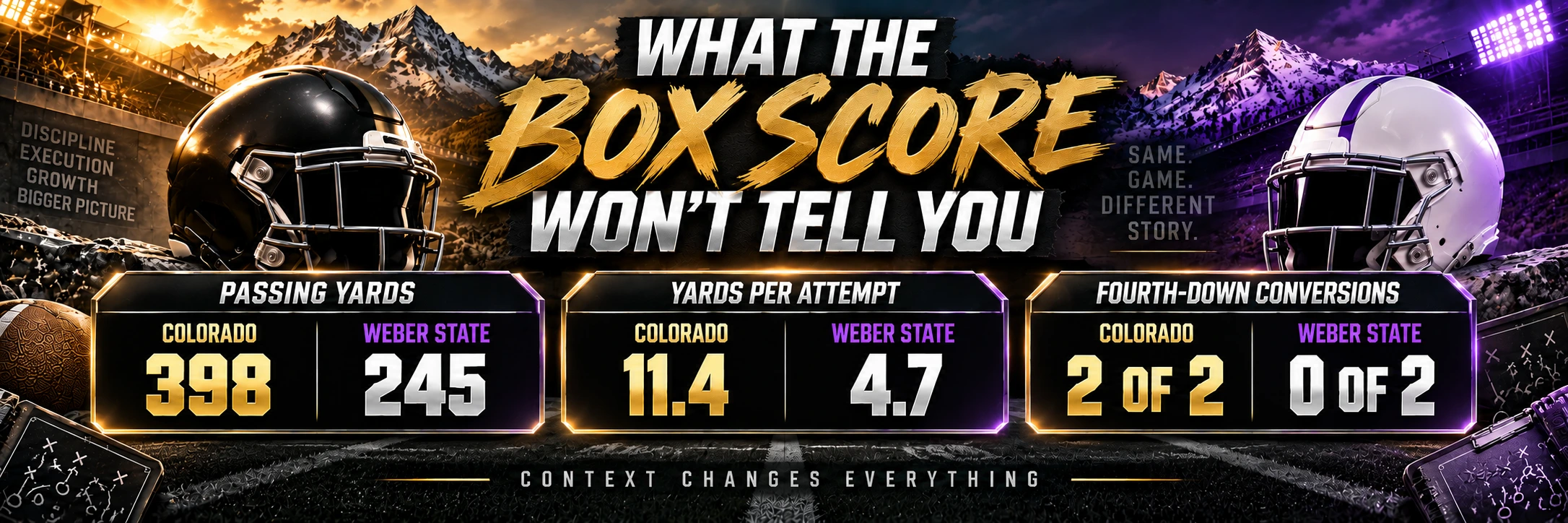
A box score can’t tell you whether Julian Lewis solved a defense or whether a defense simply wasn’t built to be solved. Weber State’s only game before facing Colorado was a 30-29 squeaker over Northern Colorado — a game in which they gave up roughly 379 passing yards. That wasn’t a run-defense problem. That was a secondary with cracks already showing before Colorado ever took the field. Eleven-point-four against a defense that porous through the air and eleven-point-four against a Big 12 secondary are the same number describing two entirely different jobs. The stat sheet doesn’t know the difference. It just records the yardage.
It also can’t tell you when things happened, only that they happened. Turnovers finished even, two apiece — a wash on paper. But a fumble lost while up thirty-one points in the fourth quarter and an interception thrown while a game still hangs in the balance are not the same event wearing the same label. Colorado’s turnovers came with the outcome already decided. That’s not nothing — sloppy is still sloppy — but it’s not the same sloppy that costs a team a one-score game in October.
The two fourth-down conversions carry the same blind spot. Going 2-for-2 looks like conviction. It might also just be a team that trusted its offense against a front that couldn’t get off blocks — and there’s no line in the box score that tells you which one it actually was until the same call gets tried against a defense that can answer it. The box score doesn’t come with a laugh track, either, so nobody’s going to tell you how it sounded on the Weber State sideline by the third quarter. Some things you just have to imagine.
And the biggest thing the numbers can’t say yet: the Unsung Player field in this breakdown is still blank, on purpose, because the snap-level grading that would actually explain who won the trench battles and who lost their coverage assignment isn’t in yet. Everything above the line — the yards, the touchdowns, the splits — is real. But it’s the surface. The answer underneath it, the one that actually predicts what happens against a team that can contest the same plays, isn’t something Saturday’s box score was ever going to hand over on its own.
Here’s where it gets more honest than a highlight package wants to be.
Two games in, Colorado has shown two completely different versions of itself, and both of them are true at the same time.
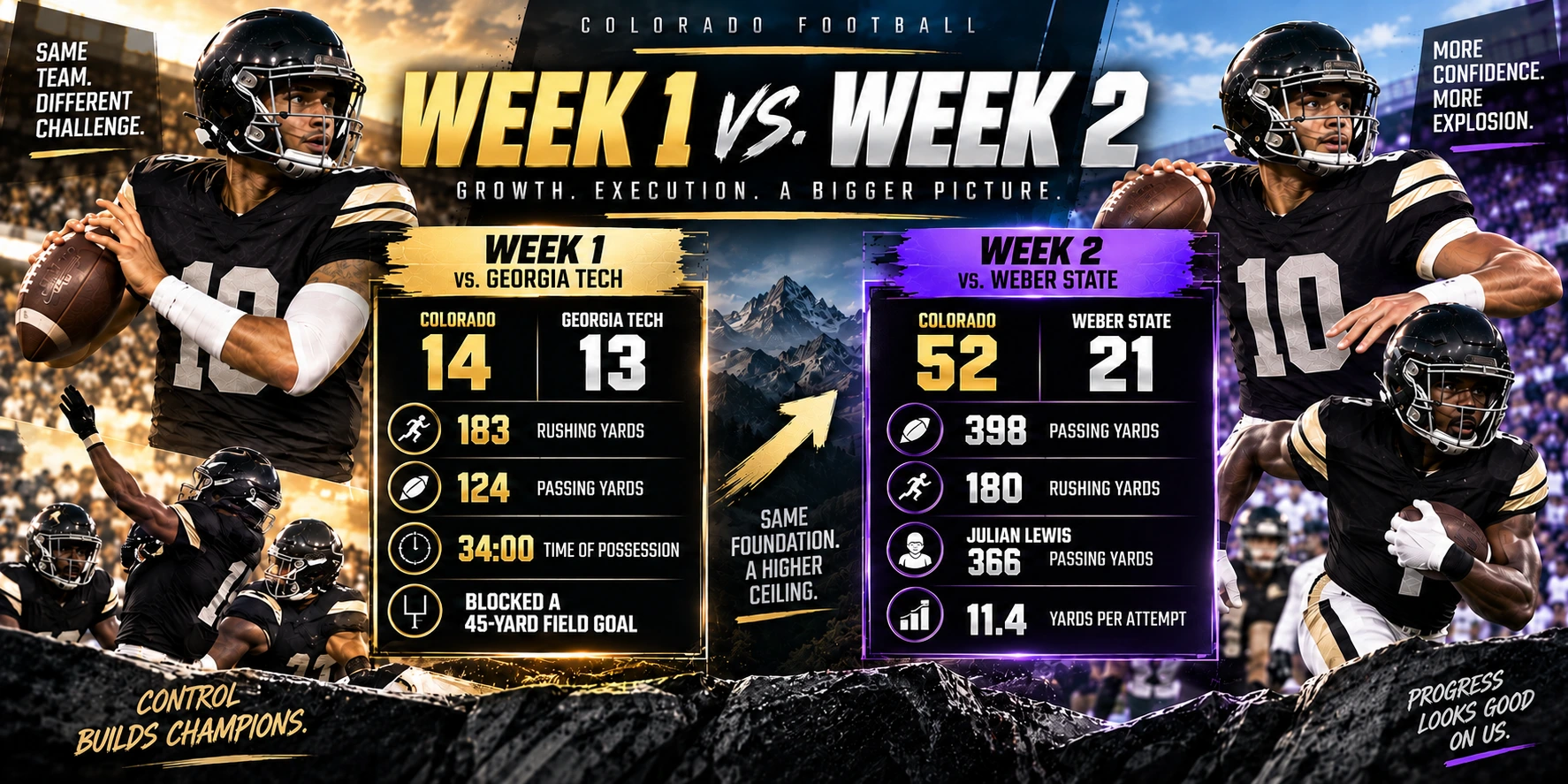
Version one showed up at Georgia Tech in Week 1: a offense that ground out 183 rushing yards, controlled the ball for 34 minutes, and needed a blocked field goal as time expired just to survive 14–13. Julian Lewis threw for 124 yards that night. Not a typo — 124, on a night that came down to an eight-play, 75-yard drive in the final 1:40 and Boo Carter getting a hand on a 45-yard kick. That is a team that wins ugly, wins late, and wins ground-and-pound.
Version two showed up Saturday: an offense that scored on five different possessions through the air, got a 55-yard touchdown run from Micah Welch on top of it, and made 11.4 yards a snap look routine. That is not the same team that squeezed out fourteen points a week earlier. Or — and this is the part worth sitting with — it’s exactly the same team, just finally getting to play with the accelerator all the way down against a defense that couldn’t make it pay for trying.
The run game is the through-line connecting both nights, and it’s maturing in a way that’s easy to miss if you only watch the scoreboard. At Georgia Tech, the ground game was the whole plan — 183 yards, 1.7 yards allowed per carry on defense flipping the pregame run-D storyline completely, a team leaning on establishing the run because it had to. Against Weber State, the run game wasn’t the plan. It was the complement — 180 yards on 38 carries, spread across three different scorers, while Lewis did the heavy lifting through the air. A run game that can carry a team on a bad passing night in Week 1 and take a back seat on a big passing night in Week 2 without missing a step either way — that’s not just production. That’s the sign of an identity settling in, not just a stat line showing up.
Now the part that has to be said plainly, because it’s the honest version and not the comfortable one: neither of those two performances tells you what happens against a Big 12 pass rush that isn’t Weber State’s, or a road environment that isn’t a business trip. Julian Lewis is 2–0. He’s produced a game-winning fourth-quarter drive against real competition and a five-touchdown outburst against overmatched competition. Both are real. Neither one is the same test as what’s coming. Northwestern is next, on the road, non-conference. Then the Big 12 opens for real at Baylor, and after that it doesn’t let up — Texas Tech, Utah, Oklahoma State, Kansas State, Arizona State, Houston, Cincinnati, UCF. Eight conference games, and the schedule doesn’t care how many yards a freshman threw for against an FCS opponent in September.
Does the record so far buy him confidence? It should. A quarterback who can manage 124 unspectacular yards and still deliver the winning drive under pressure has already shown something a stat sheet from a blowout can’t measure. But confidence and readiness aren’t the same purchase, and the Big 12 schedule is about to ask Julian Lewis a question Weber State never could.
Same question, different uniform, on defense: Colorado’s secondary hasn’t been truly tested yet, either. Georgia Tech’s Alberto Mendoza threw for 237 yards on 17-of-23 with a 160.5 rating and connected on a 42-yard strike in the final minute that nearly cost Colorado the game outright. Weber State’s Nate Dahle threw three touchdowns to Noah Kjar’s tandem targets despite a 4.7 yards-per-attempt average that made the box score look worse than the two scoring connections felt in real time. Two different opponents, two different arms, and in both games there were stretches where a good throw found room. Texas Tech and Utah are not going to be shy about testing that. Neither is Cincinnati. The pass rush and turnover numbers look good through two weeks. The two weeks haven’t included a offense built to make a living exploiting exactly this.
None of this is meant as a wet blanket on a 52-point night. It’s meant as the thing worth remembering before anybody starts writing the rest of the season for this team: Colorado went 3–9 a year ago, 1–8 in Big 12 play, and closed the season on a five-game losing streak after a stretch that looked, for a moment, like it was turning a corner. That’s not a threat hanging over this team. It’s the reason 2–0 gets watched a little more closely than it would anywhere else — the reason the question isn’t just “can they beat Weber State,” it’s “is this the version of Colorado that shows up in November, or is it the one that didn’t.” Nobody’s writing that answer in September. But it’s why the run game maturing and Julian Lewis growing into the job matter more than the final score does.
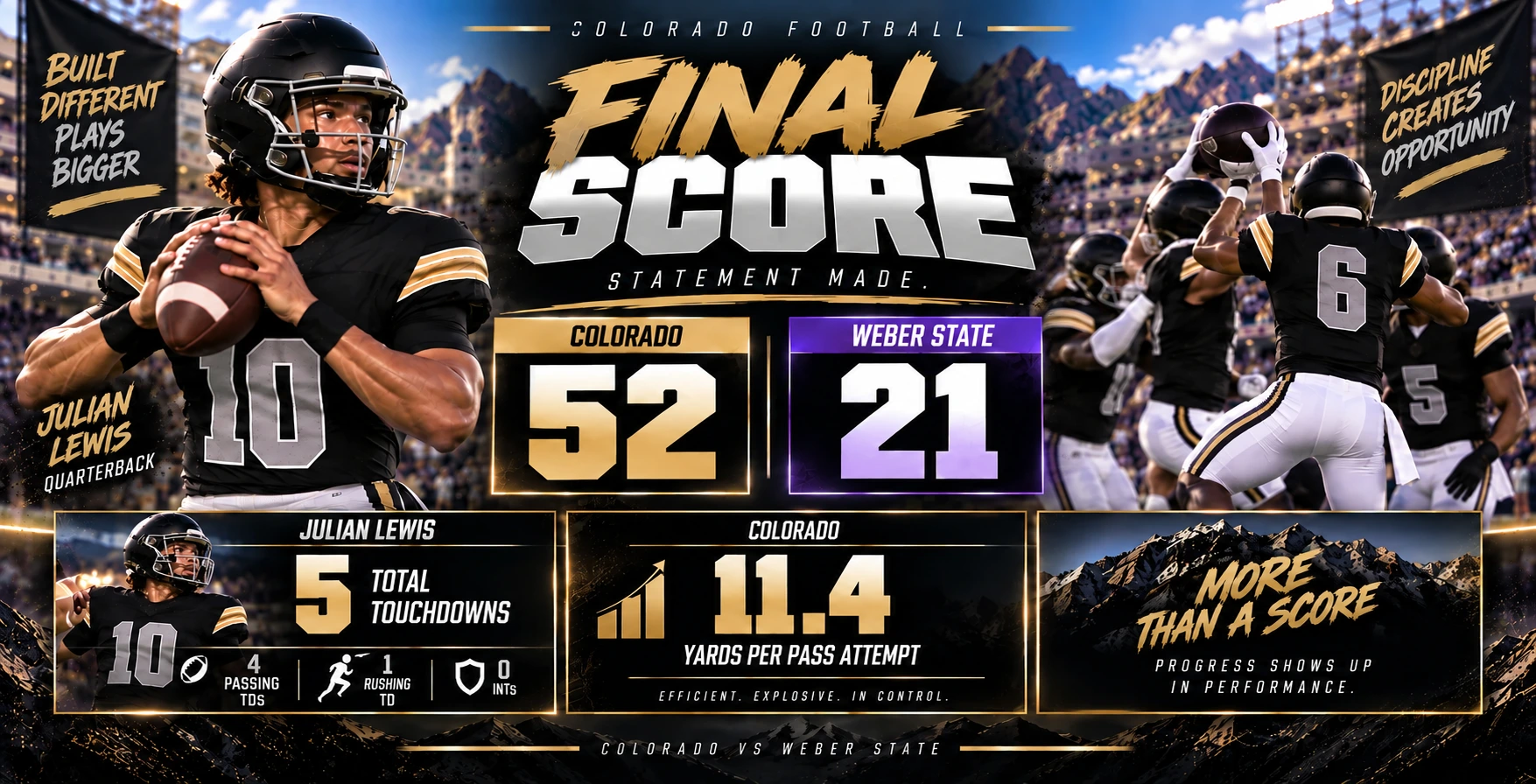
Weber State will go back to Ogden with Nate Dahle’s three touchdown passes and Noah Kjar’s two touchdown catches and not much else to show for a night when the yards per throw told the real story before the fourth quarter did. Colorado goes to Week 3 with a number worth remembering — not 52, not 398, but 11.4 — and a redshirt freshman quarterback who has now made that number look less like a fluke and more like a floor.
Folsom Field emptied out slow Saturday night. Nobody was really in a hurry to leave.
You're one of our first visitors. This site is still under development — if you spot anything off, please let us know. Your eyes help us build something great.
Your feedback and this page’s address are sent to TLP Sports Club using Google Forms. Privacy Policy
Fan Discussion
Choose a display name and join the conversation. No GitHub sign-in.