
Red zone
The area between the 20-yard line and the opponent’s goal line.
 TLP Football School
 Plain answers for the football words, phrases, and signals that can make a broadcast sound like another language.
Hear a term you do not know? Find the short answer here, then return to the game with the meaning in hand.
The area between the 20-yard line and the opponent’s goal line.
When the team with the ball loses possession to the other team.
When the defense sends extra players to pressure the passer.
A returner’s signal to stop the play and catch a punt without advancing it.
Browser voice · ready when you are
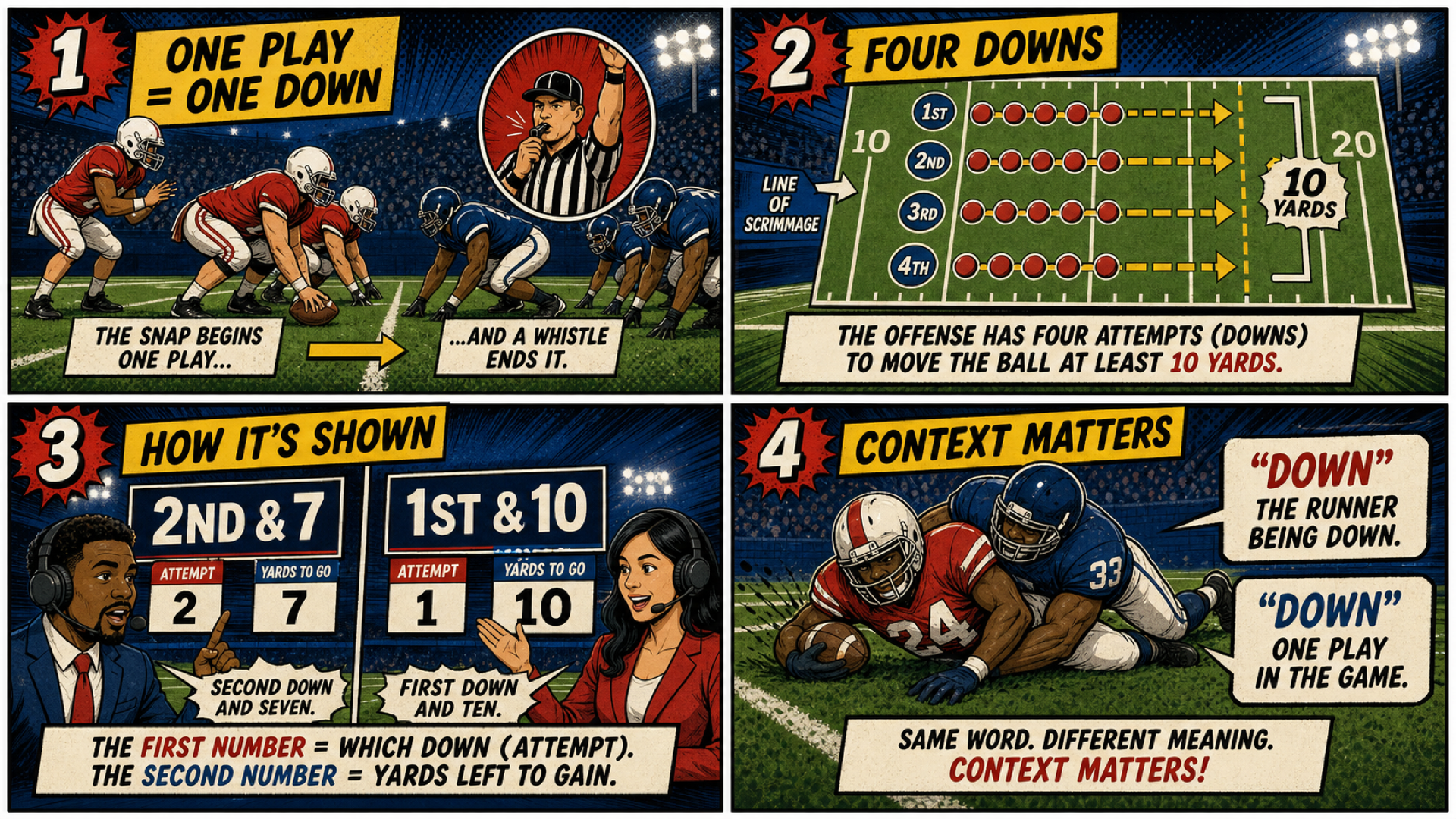
A down is one play. It is a single attempt by the offense to move the ball forward. The NFL rulebook defines it as a period of action that starts when the ball is put in play and ends when the ball is declared dead (Rule 3, Section 8). The NCAA defines it as a unit of the game that starts with a legal snap and ends when the ball becomes dead (Rule 2, Section 7).
A down is one play — one attempt by the offense to move the ball forward.
The offense gets four downs to move the ball at least ten yards. If they succeed, they earn a first down and get four fresh attempts. If they fail, the other team gets the ball.
When you hear second and seven, the first word tells you which down (second attempt) and the number tells you how many yards are left (seven). First and ten means a new set of downs with ten yards ahead.
The word down also means the play is over. When a runner is tackled, the runner is down. Same word, two uses — context tells you which.
Both rulebooks define a down: a period of action from snap to dead ball. NFL Rule 3, Section 8. NCAA Rule 2, Section 7.
A down is one play — one attempt by the offense to move the ball forward.
The offense gets four downs to move the ball at least ten yards. If they succeed, they earn a first down and get four fresh attempts. If they fail, the other team gets the ball.
When you hear second and seven, the first word tells you which down (second attempt) and the number tells you how many yards are left (seven). First and ten means a new set of downs with ten yards ahead.
The word down also means the play is over. When a runner is tackled, the runner is down. Same word, two uses — context tells you which.
Both rulebooks define a down: a period of action from snap to dead ball. NFL Rule 3, Section 8. NCAA Rule 2, Section 7.
Swipe, drag, or use the arrows to turn the page.
Plain Text and the Comic Book Illustrated Answer are available now. Video stays part of the same answer box, so the experience can grow without changing how people learn.
Browser voice · ready when you are
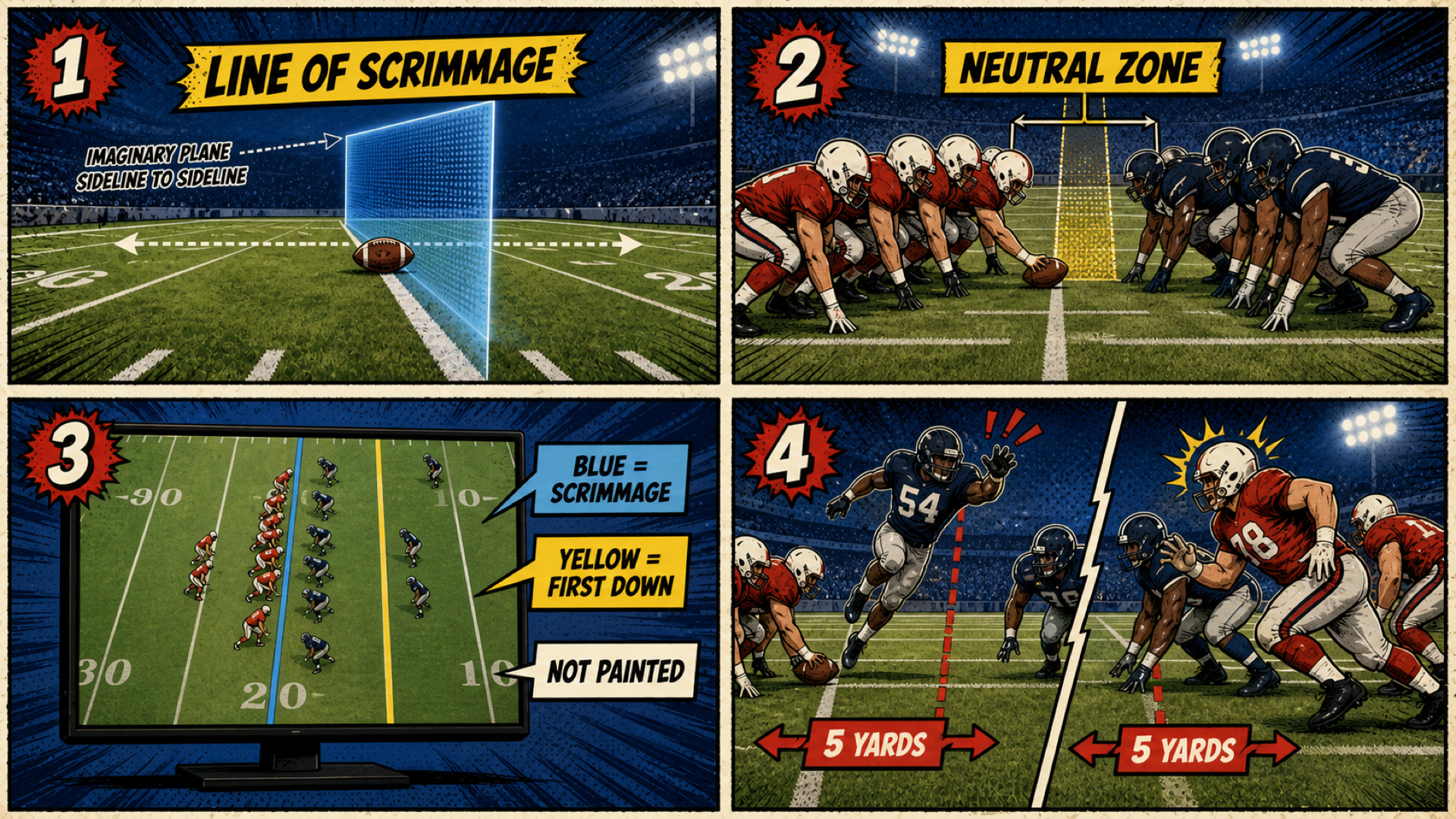
The line of scrimmage is the yard line where the ball sits before the snap. It is not a painted line — it is an imaginary vertical plane running from sideline to sideline through the tip of the ball closest to each team’s goal line.
The line of scrimmage is the yard line where the ball sits before the snap. It is not a painted line — it is an imaginary vertical plane running from sideline to sideline through the tip of the ball.
Both teams line up on their side of it. The gap between the two lines is the neutral zone — the space between the forward and backward points of the ball. No player except the center can be in the neutral zone at the snap.
On television, the blue line is the line of scrimmage and the yellow line is the first-down marker. Neither is painted on the field — both are broadcast graphics.
The NFL defines the scrimmage line as the vertical plane through the forward point of the ball (Rule 3, Section 18). The NCAA defines it as the yard line through the point of the ball nearest a team’s own goal line (Rule 2, Section 21).
The line of scrimmage is the yard line where the ball sits before the snap. It is not a painted line — it is an imaginary vertical plane running from sideline to sideline through the tip of the ball.
Both teams line up on their side of it. The gap between the two lines is the neutral zone — the space between the forward and backward points of the ball. No player except the center can be in the neutral zone at the snap.
On television, the blue line is the line of scrimmage and the yellow line is the first-down marker. Neither is painted on the field — both are broadcast graphics.
The NFL defines the scrimmage line as the vertical plane through the forward point of the ball (Rule 3, Section 18). The NCAA defines it as the yard line through the point of the ball nearest a team’s own goal line (Rule 2, Section 21).
Swipe, drag, or use the arrows to turn the page.
Plain Text and the Comic Book Illustrated Answer are available now. Video stays part of the same answer box, so the experience can grow without changing how people learn.
Browser voice · ready when you are
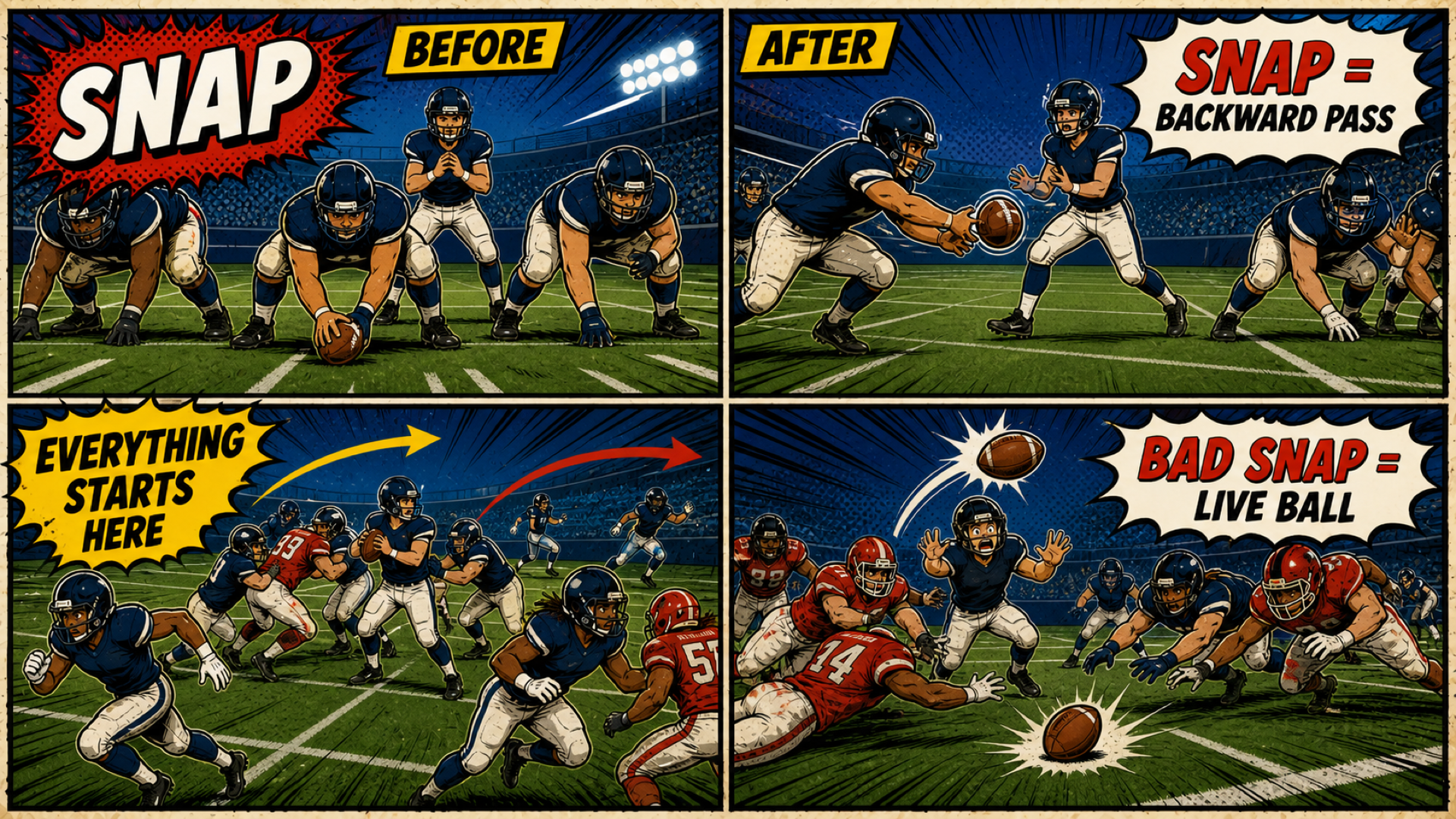
The snap is how every scrimmage play begins. The center, who is the offensive player in the middle of the line, puts the ball in play by passing it backward between his legs to the quarterback or another player behind him.
The snap is how every scrimmage play begins. The center passes the ball backward between his legs to the quarterback or another player behind him.
Both rulebooks define the snap as a backward pass that puts the ball in play. NFL Rule 3, Section 31. NCAA Rule 2, Section 23.
Before the snap, the ball is on the ground. No one can move it until the center snaps it. The snap is also a timing mechanism — receivers start routes, linemen block, and the play begins the moment the ball moves.
A bad snap is a live ball. Both teams can recover it. Games have been decided by a single bad snap.
The snap is how every scrimmage play begins. The center passes the ball backward between his legs to the quarterback or another player behind him.
Both rulebooks define the snap as a backward pass that puts the ball in play. NFL Rule 3, Section 31. NCAA Rule 2, Section 23.
Before the snap, the ball is on the ground. No one can move it until the center snaps it. The snap is also a timing mechanism — receivers start routes, linemen block, and the play begins the moment the ball moves.
A bad snap is a live ball. Both teams can recover it. Games have been decided by a single bad snap.
Swipe, drag, or use the arrows to turn the page.
Plain Text and the Comic Book Illustrated Answer are available now. Video stays part of the same answer box, so the experience can grow without changing how people learn.
Browser voice · ready when you are
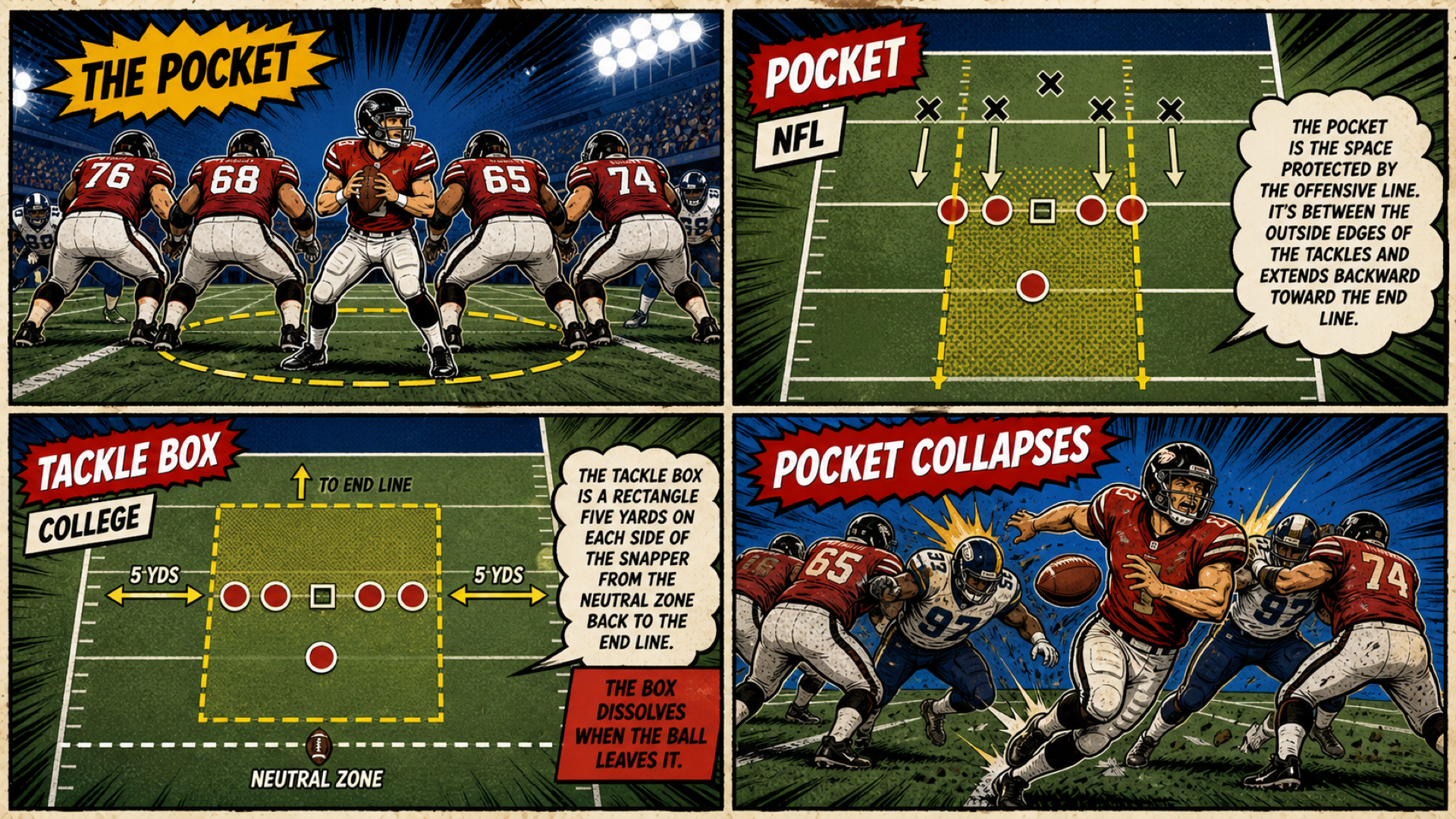
The pocket is the protected space the offensive line creates around the quarterback on a passing play. The five linemen form a wall, and the area behind them where the quarterback stands and throws is the pocket.
The pocket is the protected space behind the offensive line where the quarterback stands and throws on a passing play.
The NFL rulebook defines the pocket area as the space between the outside edges of the normal tackle positions, extending backward to the end line (Rule 3, Section 25). Once the quarterback or ball moves outside it, the pocket no longer exists.
College football does not formally define the pocket. Instead, it uses the tackle box — a rectangle five yards on each side of the snapper, from the neutral zone to the end line (Rule 2, Section 34). The tackle box disintegrates when the ball leaves it.
When the pocket collapses, the defensive rush broke through the offensive line. The quarterback is scrambling, getting sacked, or throwing under pressure.
The pocket is the protected space behind the offensive line where the quarterback stands and throws on a passing play.
The NFL rulebook defines the pocket area as the space between the outside edges of the normal tackle positions, extending backward to the end line (Rule 3, Section 25). Once the quarterback or ball moves outside it, the pocket no longer exists.
College football does not formally define the pocket. Instead, it uses the tackle box — a rectangle five yards on each side of the snapper, from the neutral zone to the end line (Rule 2, Section 34). The tackle box disintegrates when the ball leaves it.
When the pocket collapses, the defensive rush broke through the offensive line. The quarterback is scrambling, getting sacked, or throwing under pressure.
Swipe, drag, or use the arrows to turn the page.
Plain Text and the Comic Book Illustrated Answer are available now. Video stays part of the same answer box, so the experience can grow without changing how people learn.
Browser voice · ready when you are
The red zone is the area between the opponent’s 20-yard line and the goal line. When the offense enters this area, they are close enough that they should come away with points — either a touchdown or at least a field goal.
The red zone is the area between the opponent’s 20-yard line and the goal line. When the offense enters this area, they are close enough to score.
Neither the NFL rulebook nor the NCAA rulebook defines the red zone. It is a coaching and broadcast term, not a rules term.
Red zone efficiency measures how often a team scores when they get inside the opponent’s 20. A team that reaches the red zone and comes away empty is leaving points on the field.
The field gets shorter inside the 20. There is less room for the offense to spread out and less room for the defense to cover. The game becomes tighter and more physical.
The red zone is the area between the opponent’s 20-yard line and the goal line. When the offense enters this area, they are close enough to score.
Neither the NFL rulebook nor the NCAA rulebook defines the red zone. It is a coaching and broadcast term, not a rules term.
Red zone efficiency measures how often a team scores when they get inside the opponent’s 20. A team that reaches the red zone and comes away empty is leaving points on the field.
The field gets shorter inside the 20. There is less room for the offense to spread out and less room for the defense to cover. The game becomes tighter and more physical.
When this answer gets its comic pages, they will appear here one page at a time.
Plain Text and the Comic Book Illustrated Answer are available now. Video stays part of the same answer box, so the experience can grow without changing how people learn.
Browser voice · ready when you are
A turnover is when the team with the ball loses possession to the other team. The most common turnovers are interceptions and fumble recoveries.
A turnover is when the team with the ball loses possession to the other team — through an interception, a fumble recovery, or a turnover on downs.
An interception happens when a defender catches a pass intended for the offense. A fumble happens when the ball carrier drops the ball and the other team recovers it. A turnover on downs happens when the offense fails to convert on fourth down.
Neither rulebook formally defines the word turnover. The NFL defines change of possession (Rule 3, Section 35) as when the defense secures possession of a kicked, passed, or fumbled ball, or when the ball is awarded to the opposing team by rule.
Turnovers are among the most important plays in football. They give the other team the ball — often in good field position — without a kickoff or punt. The team that wins the turnover battle usually wins the game.
A turnover is when the team with the ball loses possession to the other team — through an interception, a fumble recovery, or a turnover on downs.
An interception happens when a defender catches a pass intended for the offense. A fumble happens when the ball carrier drops the ball and the other team recovers it. A turnover on downs happens when the offense fails to convert on fourth down.
Neither rulebook formally defines the word turnover. The NFL defines change of possession (Rule 3, Section 35) as when the defense secures possession of a kicked, passed, or fumbled ball, or when the ball is awarded to the opposing team by rule.
Turnovers are among the most important plays in football. They give the other team the ball — often in good field position — without a kickoff or punt. The team that wins the turnover battle usually wins the game.
When this answer gets its comic pages, they will appear here one page at a time.
Plain Text and the Comic Book Illustrated Answer are available now. Video stays part of the same answer box, so the experience can grow without changing how people learn.
Browser voice · ready when you are
A blitz is when the defense sends more players than usual to rush the quarterback. On a typical passing play, the defensive line rushes the quarterback while the linebackers and defensive backs stay back in coverage. On a blitz, one or more of those coverage players abandon their zone or man assignment and charge at the quarterback instead.
A blitz is when the defense sends extra players to rush the quarterback beyond the typical four-man pass rush. Linebackers, safeties, or cornerbacks leave their coverage assignments and charge at the quarterback.
Neither the NFL rulebook nor the NCAA rulebook defines the word blitz. It is a coaching and broadcast term, not a rules concept.
A blitz is a gamble. If the extra rusher reaches the quarterback, the result is a sack, a hurried throw, or a turnover. If the quarterback sees it coming and throws to the uncovered receiver, the defense gives up a big play.
Different blitzes are named by who is rushing: linebacker blitz, safety blitz, corner blitz. The more unexpected the blitzer, the harder it is for the offense to pick up.
A blitz is when the defense sends extra players to rush the quarterback beyond the typical four-man pass rush. Linebackers, safeties, or cornerbacks leave their coverage assignments and charge at the quarterback.
Neither the NFL rulebook nor the NCAA rulebook defines the word blitz. It is a coaching and broadcast term, not a rules concept.
A blitz is a gamble. If the extra rusher reaches the quarterback, the result is a sack, a hurried throw, or a turnover. If the quarterback sees it coming and throws to the uncovered receiver, the defense gives up a big play.
Different blitzes are named by who is rushing: linebacker blitz, safety blitz, corner blitz. The more unexpected the blitzer, the harder it is for the offense to pick up.
When this answer gets its comic pages, they will appear here one page at a time.
Plain Text and the Comic Book Illustrated Answer are available now. Video stays part of the same answer box, so the experience can grow without changing how people learn.
Browser voice · ready when you are
A fair catch is when a player receiving a kick raises one arm straight up above his head before catching the ball. That signal tells everyone on the field: I am not going to run with this. Do not hit me.
A fair catch is when a player receiving a kick raises one arm above his head before catching the ball. The signal means he will not run with it and no one is allowed to hit him.
The play is dead at the spot of the catch. The receiving team starts their drive from there.
Fair catches are most commonly seen on punts. The returner sees defenders closing in and signals to protect himself rather than risk a hit.
In college, a fair catch is allowed on kickoffs. If the returner catches the ball behind the 25-yard line, it is placed at the 25. The NFL also permits the fair catch on kickoffs under the 2026 rules.
Both rulebooks define the fair catch. NFL Rule 10, Section 2. NCAA Rule 2, Section 8.
A fair catch is when a player receiving a kick raises one arm above his head before catching the ball. The signal means he will not run with it and no one is allowed to hit him.
The play is dead at the spot of the catch. The receiving team starts their drive from there.
Fair catches are most commonly seen on punts. The returner sees defenders closing in and signals to protect himself rather than risk a hit.
In college, a fair catch is allowed on kickoffs. If the returner catches the ball behind the 25-yard line, it is placed at the 25. The NFL also permits the fair catch on kickoffs under the 2026 rules.
Both rulebooks define the fair catch. NFL Rule 10, Section 2. NCAA Rule 2, Section 8.
When this answer gets its comic pages, they will appear here one page at a time.
Plain Text and the Comic Book Illustrated Answer are available now. Video stays part of the same answer box, so the experience can grow without changing how people learn.
Browser voice · ready when you are
A fumble is any act, other than a pass or a kick, that results in a player losing possession of the ball. The ball is now live, and either team can recover it.
A fumble is any act, other than a pass or a kick, that results in a player losing possession of the ball. The ball is live, and either team can recover it.
A fumble is different from an incomplete pass. An incomplete pass is dead immediately. A fumble stays live.
A muff is when a player tries to catch a ball not in his possession and fails. It does not change the ball’s status.
An intentional fumble forward is treated as a forward pass. On fourth down, only the fumbler can advance a fumbled ball.
NFL: Rule 3, Section 2, Article 5. NCAA: Rule 2, Section 11, Article 1.
A fumble is any act, other than a pass or a kick, that results in a player losing possession of the ball. The ball is live, and either team can recover it.
A fumble is different from an incomplete pass. An incomplete pass is dead immediately. A fumble stays live.
A muff is when a player tries to catch a ball not in his possession and fails. It does not change the ball’s status.
An intentional fumble forward is treated as a forward pass. On fourth down, only the fumbler can advance a fumbled ball.
NFL: Rule 3, Section 2, Article 5. NCAA: Rule 2, Section 11, Article 1.
When this answer gets its comic pages, they will appear here one page at a time.
Plain Text and the Comic Book Illustrated Answer are available now. Video stays part of the same answer box, so the experience can grow without changing how people learn.
Browser voice · ready when you are
Intentional grounding is a penalty on the quarterback for throwing the ball away to avoid a sack when no eligible receiver is in the area of the throw.
Intentional grounding is a penalty on the quarterback for throwing the ball away to avoid a sack when no eligible receiver is in the area.
The penalty is a loss of down and the ball is spotted where the quarterback threw it. If he is in his own end zone, it is a safety.
If the quarterback gets outside the pocket (NFL) or tackle box (college) and throws the ball past the line of scrimmage, it is a legal throwaway. Spiking immediately after the snap is also legal.
NFL rule: Rule 8, Section 1, Article 2. NCAA rule: Rule 7, Section 3, Article 2-h.
Intentional grounding is a penalty on the quarterback for throwing the ball away to avoid a sack when no eligible receiver is in the area.
The penalty is a loss of down and the ball is spotted where the quarterback threw it. If he is in his own end zone, it is a safety.
If the quarterback gets outside the pocket (NFL) or tackle box (college) and throws the ball past the line of scrimmage, it is a legal throwaway. Spiking immediately after the snap is also legal.
NFL rule: Rule 8, Section 1, Article 2. NCAA rule: Rule 7, Section 3, Article 2-h.
When this answer gets its comic pages, they will appear here one page at a time.
Plain Text and the Comic Book Illustrated Answer are available now. Video stays part of the same answer box, so the experience can grow without changing how people learn.
You're one of our first visitors. This site is still under development — if you spot anything off, please let us know. Your eyes help us build something great.
Your feedback and this page’s address are sent to TLP Sports Club using Google Forms. Privacy Policy