
Before the snap
Browser voice · ready when you are
Five-yard penalty.
Before the snap, the offense must follow a specific set of rules just to get a play started — and breaking any of them costs five yards before the ball even moves. The play clock, the formation, motion rules, and the threat of a false start all have to line up before the center can put the ball in the quarterback’s hands.
Five-yard penalty.
Five-yard penalty. And the ball hasn’t even been snapped yet. That’s the thing about pre-snap rules — you can lose ground before the play ever starts, and it happens all the time.
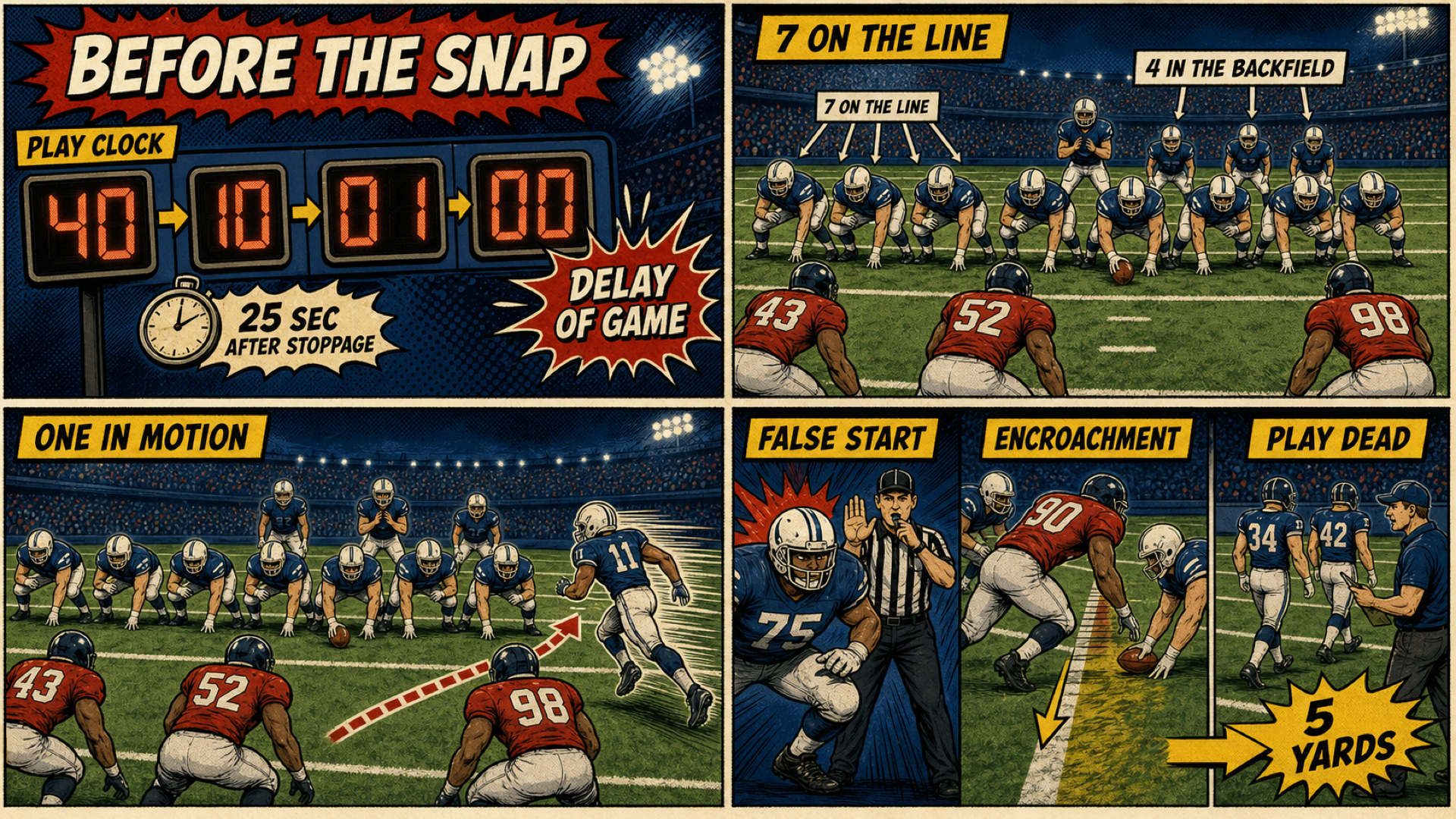
After the previous play ends, the offense has 40 seconds to snap the ball.
After the previous play ends, the offense has 40 seconds to snap the ball. That’s the play clock. If it hits zero, that’s delay of game — five yards. After certain stoppages like a timeout, the clock resets to 25 seconds.
The offense must line up with seven players on the line of scrimmage.
The offense must line up with seven players on the line of scrimmage. Not six, not eight. The other four are behind them in the backfield. Get the alignment wrong and that’s illegal formation — another five yards.
Once the offense is set and every player is still, one man is allowed to start moving.
Once the offense is set and every player is still, one man is allowed to start moving. Just one. And he has to be going sideways or backward — never toward the line of scrimmage. You’ll see a receiver or running back jog across the formation right before the snap. That’s legal motion, and offenses use it to read the defense.
If two players move at once after the offense is set, that’s an illegal shift.
If two players move at once after the offense is set, that’s an illegal shift. If the moving player is going forward, that’s illegal motion. Both are five-yard penalties.
The most common pre-snap penalty is the false start.
The most common pre-snap penalty is the false start. If any offensive player moves before the ball is snapped — even a flinch — the play is blown dead. Five yards.
The defense has rules too.
The defense has rules too. In the NFL, if a defender jumps across the line and touches an offensive player before the snap, that’s encroachment. In college, being in the neutral zone at the snap is offsides. Both are five yards.
Substitutions are part of it too.
Substitutions are part of it too. When the offense sends new players in, the defense must be given time to make their own substitutions before the ball can be snapped.
So before any snap: play clock ticking, seven on the line, everyone set for a full second…
So before any snap: play clock ticking, seven on the line, everyone set for a full second, one man in motion at most, and nobody flinching. All of that just to start a play.
Read the full answer
Five-yard penalty. And the ball hasn’t even been snapped yet. That’s the thing about pre-snap rules — you can lose ground before the play ever starts, and it happens all the time.
After the previous play ends, the offense has 40 seconds to snap the ball. That’s the play clock. If it hits zero, that’s delay of game — five yards. After certain stoppages like a timeout, the clock resets to 25 seconds.
The offense must line up with seven players on the line of scrimmage. Not six, not eight. The other four are behind them in the backfield. Get the alignment wrong and that’s illegal formation — another five yards.
Once the offense is set and every player is still, one man is allowed to start moving. Just one. And he has to be going sideways or backward — never toward the line of scrimmage. You’ll see a receiver or running back jog across the formation right before the snap. That’s legal motion, and offenses use it to read the defense.
If two players move at once after the offense is set, that’s an illegal shift. If the moving player is going forward, that’s illegal motion. Both are five-yard penalties.
The most common pre-snap penalty is the false start. If any offensive player moves before the ball is snapped — even a flinch — the play is blown dead. Five yards.
The defense has rules too. In the NFL, if a defender jumps across the line and touches an offensive player before the snap, that’s encroachment. In college, being in the neutral zone at the snap is offsides. Both are five yards.
Substitutions are part of it too. When the offense sends new players in, the defense must be given time to make their own substitutions before the ball can be snapped.
So before any snap: play clock ticking, seven on the line, everyone set for a full second, one man in motion at most, and nobody flinching. All of that just to start a play.
Swipe, drag, or use the arrows to turn the page.
See it in motion when the video is ready.
Plain Text and the Comic Book Illustrated Answer are available now. Video stays part of the same answer box, so the experience can grow without changing how people learn.